
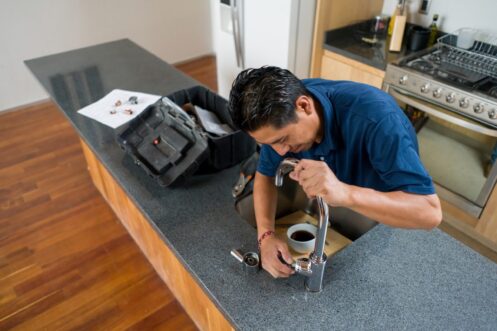
Wondering what’s causing your faucet to leak or drip? A faucet that leaks from the base while in use almost always has a worn-out O-ring or washer. A faucet that drips from the spout when off has a different worn part depending on its type: compression faucets usually need a new rubber washer or valve seat, ball faucets a worn valve seat or spring, cartridge faucets a worn O-ring or cartridge, and ceramic disc faucets a worn or broken disc. Because the failing part depends on the faucet type, the reliable fix is having a plumber identify the faucet and replace the specific worn component.
Bathroom and kitchen faucets get a lot of daily use. That means the internal components in a faucet experience quite a bit of wear and tear. Over time, this will often cause certain components to wear out and the faucet to leak or constantly drip. We’ll explain why different types of faucets can start leaking or dripping and how a household plumbing services provider can fix them for you.
Leaky vs. Dripping Faucet
Many people think that a leaking faucet is the same as one that drips. When professional plumbers talk about these things, they’re usually referring to two separate issues that have different root causes. A dripping faucet is one from which small drops of water continually drip when it’s not in use. With a leaking faucet, water comes out of the base or somewhere else it’s not supposed to when the fixture is in use.
A dripping faucet can be a bigger issue in one way due to the amount of water it can waste. The average dripping faucet will produce around 10 drops per minute and waste approximately 1 gallon of water per day. If you have a faucet that’s dripping a drop a second, it can waste nearly 6 gallons of water in a single day.
Leaking faucets can also be a serious concern due to the water potentially damaging the area around the sink. If the faucet has a major leak, you can also end up with poor water pressure at the spout.
Types of Faucets and What Can Cause Them to Leak or Drip
There are four primary types of faucets, and each one can end up dripping or leaking for various reasons. Water leaking out from around the base of the faucet or the faucet body when the faucet is in use is almost always a result of a worn-out rubber O-ring or worn-out washer. Dripping also indicates a worn-out component, but the specific component that can cause a faucet to drip may differ depending on what type of faucet it is. This is one reason why it’s a good idea to call a professional plumber when dealing with faucet issues. They will be able to immediately determine the type of faucet and then diagnose what’s causing it to leak or drip.
Compression Faucets
This is the most basic type of faucet and not something you see much these days outside of old homes or utility sinks. The easiest way to tell a compression faucet apart from the others is that the hot and cold handles screw upward to turn the water on and then downward to turn the water off. Inside each handle is a screw with a rubber washer at the end. When the water is off, the washer sits against a component known as the valve seat and creates a watertight seal. When you turn the water on, the screw and washer move upward to allow water to start flowing around the valve seat.
Compression faucets are generally the most prone to dripping and have the shortest lifespan. With this type of faucet, dripping almost always results because either the rubber washer or the valve seat is worn out. Replacing a worn-out washer is a simple fix. Replacing a valve seat can also be quite easy. However, the valve seat in some faucets can’t be replaced. It’s also common for the valve seat to get stuck and be impossible to remove. If you have an old compression faucet that’s dripping, replacing it with one of the other types will often be the best option.
Ball Faucets
Ball faucets are also relatively simple and are commonly found in both bathrooms and kitchens. This type of faucet has a single handle located on top just behind the spout. The handle rotates on a round cap as you adjust the temperature and flow rate of the water. Inside the body of the faucet is a metal or plastic ball that has holes in it. When you turn the handle, the position of the holes shifts to allow water to start flowing. The position of the holes also determines how much hot or cold water can flow.
Ball faucets also have two valve seat gaskets that ensure water can’t flow when the faucet is off, and each gasket is held in place with a spring. When you have a ball faucet that drips, it’s a sign that at least one of the valve seats or one of the springs is damaged or worn out.
Cartridge Faucets
Cartridge faucets have two handles and look quite similar to compression washer faucets. The difference is that the handles on a cartridge faucet turn instead of you having to screw them up and down. Inside the handle is a cartridge, which is a piece of metal, ceramic or plastic that sits on a valve seat. There’s also a rubber O-ring between the cartridge and the valve seat. When you turn the handle, it raises the cartridge to allow water to start flowing. The further you turn the handle, the more the cartridge raises to allow more water to flow.
If you have this type of faucet that’s dripping, it always means that either the rubber O-ring or the cartridge itself is worn out. Replacing the O-ring is easy and inexpensive. Replacing a worn-out cartridge can be more costly, as some of them cost over $100. Ceramic cartridges are usually the most expensive, but they also tend to last the longest and are the least prone to leaking.
Ceramic Disc Faucets
This type of faucet has a single handle that you move sideways and downward to turn the water on. You can then adjust the temperature of the water by rotating the handle. The handle is connected to a cylindrical mixing chamber, which is where the hot and cold water flowing into the faucet mix as you adjust the temperature. Within this chamber are two ceramic discs. One disc is stationary, while the other rotates and moves upward when you turn the water on. The position of the two discs relative to one another determines the volume of hot water and cold water that can flow.
Disc faucets are extremely reliable and less prone to dripping because they have no rubber O-rings. Nonetheless, the ceramic discs can wear down over time or break, resulting in a constantly dripping faucet. When this happens, all a plumber needs to do to stop the faucet from dripping is replace one or both discs.
If you’re dealing with a leaky or dripping faucet or have any other issues with your plumbing, you can count on the professionals at Liberty Comfort Systems for help. As one of the leading plumbing services in Anoka, MN, we can assist with all of your repair and installation needs and ensure that every part of your plumbing system is in good condition and works as it should.
To schedule a service call and get your faucet issues professionally fixed, contact Liberty Comfort Systems today.
Leaky & Dripping Faucets — FAQ
What’s the difference between a leaking and a dripping faucet? A dripping faucet releases small drops from the spout when it’s turned off, while a leaking faucet lets water escape from the base or body while it’s in use. They usually have different root causes.
Why is my faucet leaking from the base? Water escaping around the base or body during use is almost always caused by a worn-out rubber O-ring or washer.
Why does my faucet keep dripping when it’s off? Dripping points to a worn internal part, and which part depends on the faucet type: a washer or valve seat on compression faucets, a valve seat or spring on ball faucets, an O-ring or cartridge on cartridge faucets, or a ceramic disc on disc faucets.
How much water does a dripping faucet waste? An average dripping faucet loses about 1 gallon a day (roughly 10 drops per minute). A faucet dripping once per second can waste nearly 6 gallons in a day.
Which faucet type is least likely to leak? Ceramic disc faucets are the most reliable and least prone to dripping because they have no rubber O-rings, though the discs themselves can eventually wear or break.
Should I repair or replace a dripping faucet? Often it’s a simple part replacement. But for an old compression faucet with a stuck or non-replaceable valve seat, replacing the whole faucet with a more reliable type is usually the better option. A plumber can identify the faucet and recommend the most cost-effective fix.
